If you’re searching for a baby swimming class in Ara Damansara or Puchong, the short answer is: babies as young as 6 months can start, and the first few lessons look nothing like a formal “swimming lesson.” At Skywhale Swimming Academy, our Baby Swimming programme (6–42 months) is built around water adaptation and parent-guided comfort, not strokes — here’s exactly what to expect before you book a trial.
What Age Can My Baby Start Swimming Lessons?
Skywhale’s Baby Swimming class is designed for infants and young toddlers aged 6 to 42 months. That lower bound isn’t arbitrary — by around 6 months, most babies have the head and neck control needed to safely experience supported movement in water. If your child is older than 42 months, our Kiddie Swimming Class picks up from there with more structured, stroke-focused lessons.
What Actually Happens in a Baby Swimming Class?
A baby this age can’t follow verbal instructions, so the class isn’t built around listening — it’s built around sensation, movement, and repetition. Every session works through four building blocks:
- Water Adaptation — getting comfortable with water on the face, ears, and body without distress
- Floating Awareness — feeling buoyancy and how the body sits in water, fully supported by the coach or parent
- Gentle Movement Patterns — simple guided motions that build body awareness and coordination
- Safe Exposure Routine — a consistent, repeated structure each week, since predictability is what builds a baby’s confidence over time
None of this is about “teaching a baby to swim” in the way most parents picture it. It’s about building comfort and trust in water early, at a pace the baby sets.

Do Parents Get in the Pool With Their Baby?
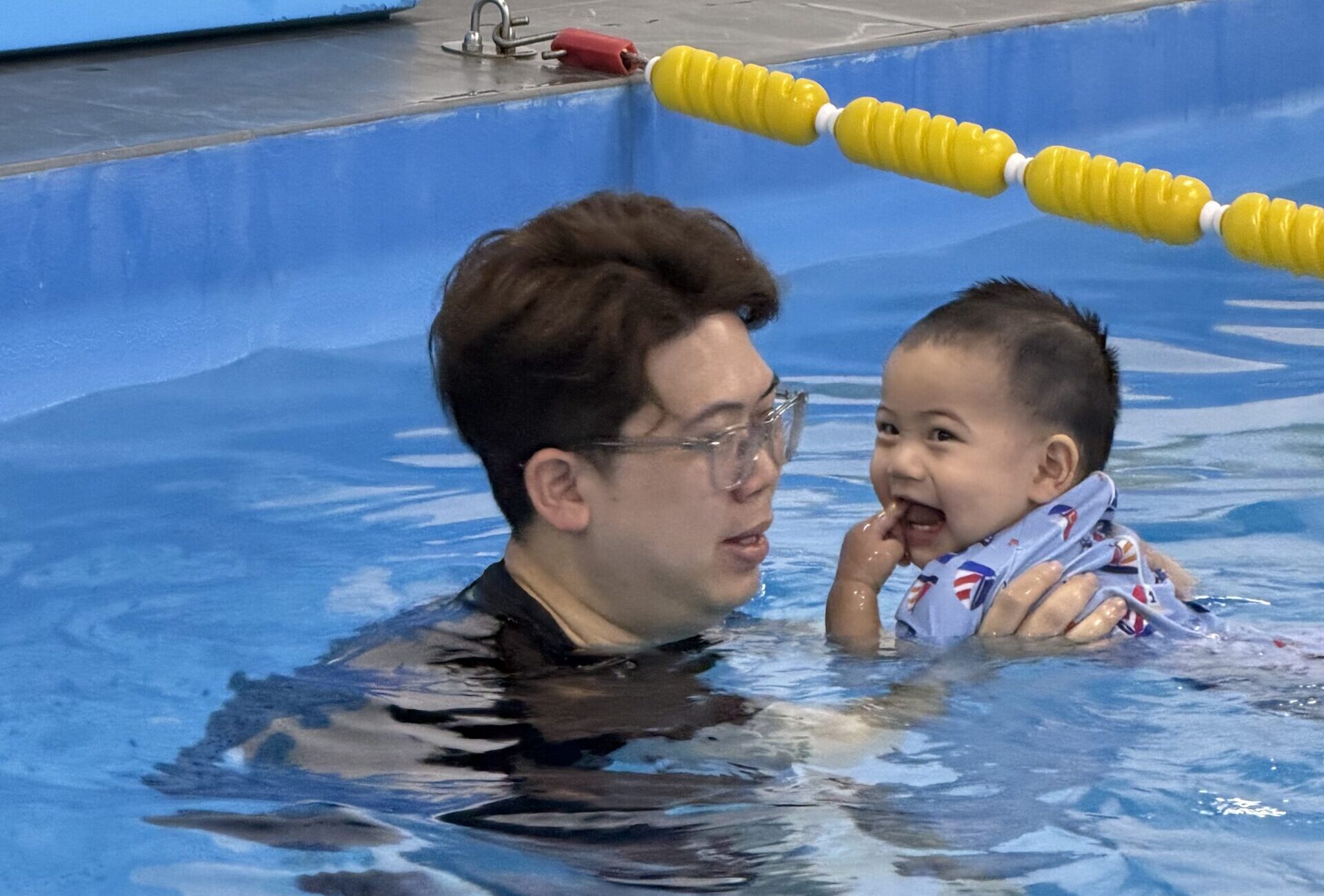
Yes — and this is the part first-time parents are often surprised by. Baby Swimming at Skywhale is a guided parent participation class: you’re in the water with your baby the whole time, working alongside a trained coach. You’ll be shown how to hold, cue, and comfort your baby safely in water, so the skills carry over to bath time and pool visits outside of class too.
It also means the class doubles as bonding time. Babies can’t understand words yet, but they clearly register a parent’s calm presence — and being held by a familiar person while trying something new is a big part of why babies settle into the water as quickly as they do.
Is It Safe for a Baby This Young?
Safety is the reason most of the class structure exists in the first place. A few specifics worth knowing:
- Pools are heated to around 32°C — noticeably warmer than a standard lap pool, and closer to a comfortable temperature for an infant’s smaller body mass.
- Classes run in small groups with a trained coach and guided parent participation, so no baby is left unsupported in the water.
- Coaches are SSI-certified, and every class is supervised by a Head Coach — our founder is himself an SSI Teacher Instructor, a credential that trains other certified swim teachers, not just students.
- Progress is paced to the baby, not a schedule — if a baby is uneasy in a session, coaches slow down rather than push through, and comfort level determines when to introduce the next activity.
Families waiting their turn aren’t left standing poolside either — both branches have an air-conditioned lounge with a live CCTV feed of the pool, so you can watch even when you’re not the one in the water.
What Does a Baby Swimming Package Cost?
As listed on our Baby Swimming programme page, the current Flexi 12 Lessons package is RM783.00 (inclusive of 8% SST) for 12 lessons with 15 weeks’ validity, and Flexi 24 Lessons is RM1,441.80 for 30 weeks. There’s an extension policy if you need more time, and missed classes can be replaced based on available slots. Fees are reviewed periodically, so check the Schedule & Fees page or WhatsApp us directly for the latest pricing and trial availability before you book.
Frequently Asked Questions
What age is best to start baby swimming?
From 6 months onward, once a baby has reasonable head and neck control. There’s no upper deadline to “catch up” — starting later just means moving into the Kiddie programme sooner instead.
Will my baby cry or resist the water at first?
Some babies do, especially in the first session or two — that’s normal and expected. Classes are structured to build comfort gradually rather than force exposure, and having a parent in the water usually settles a baby faster than being handed to a stranger would.
How is a baby swimming class different from a kiddie swimming class?
Baby classes focus on water adaptation, floating awareness, and parent-guided comfort — there’s no formal stroke technique involved. Once a child moves past 42 months into the Kiddie programme, lessons shift toward structured skills and independent participation without a parent in the pool.
Which Skywhale branches offer baby swimming?
Both Ara Damansara and Puchong Jaya run the Baby Swimming programme. If you’re on the Puchong side, the swimming class in Puchong page lists that branch’s timetable and fees.
Do I need to bring anything special for my baby’s first class?
Check with your consultant when booking a trial — requirements like swim diapers can vary and it’s best to confirm directly rather than assume.
More from Skywhale: explore swimming classes across KL & Selangor, or meet the SSI-certified coaches who teach every class.